


Advantages of fiberglass reinforced polyurethane composite frame:
• Low carbon emissions
• Salt spray resistance and corrosion resistance
• Excellentinsulation performance -no grounding resistance to PlD
• High yield strength, reducing micro-cracks in solar cells
• Solid waste disposal technology for composite material extrusion frame
• Effectively mitigates stacking-induced warpage in solar modules to prevent glass fracture


 Advantages Of Composite Photovoltaic Brackets And Guide Rails
Composite material frame, as an insulating materialdoes not require grounding after system integration, whichcan effectively reduce and avoid PlD attenuation causedby ion migration of packaging materials, and maintain theefficient conversion efficiency of photovoltaic modules.
Strong Corrosion Resistance
The density is low, only 1/4 to 1/5 of carbon steel, but the tensile strength is close to or even higher than carbon steel. This design is convenient for transportation and installation, can reduce transportation costs and installation difficulties, and also reduce the burden on building foundations.
High Thermal Stability
Low coefficient of linear expansion, not prone to thermal expansion and contraction, able to resist harsh temperature changes, ensuring the structural stability of photovoltaic brackets, and not causing deformation due to temperature changes that affect the fixation and power generation efficiency of photovoltaic panels.
Flexible Design
We can design brackets of various sizes, shapes, and load-bearing capacities according to different installation scenarios and customer specific needs, achieving product customization and meeting diverse market demands.
Low Maintenance Cost
Compared to traditional brackets that reguire regular maintenance such as anti-corrosion and rust prevention, it greatly saves the manpower, material resources, and financial costs of later maintenance.
Good Aesthetics
It can showcase its various colors and surface treatment methods, which can better integrate with the surrounding environment and building appearance, enhancing the overall visual effect.
 Structura Advantages
 Same cross-section, weight reduced by 26% compared to aluminum alloy
 High strength, 2-3 times that of aluminum alloy
 Consistent with traditional bracket installation methods, no need to customize non-standard parts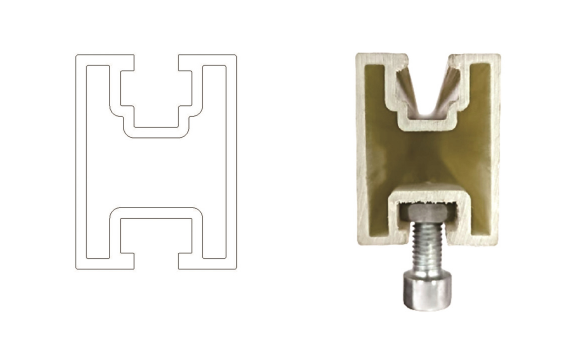
Sectionaldrawingand installation form of composite profiles
| Specifications | Texture of Material | Wall Thickness (mm) | Density (g/cm³) | Rice Weight (g/m) |
|---|---|---|---|---|
| 40X30 | Aluminum Alloy | 15 | 2.7 | 785.25 |
| 40x30 | Composite Material | 2 | 2 | 715 |
| Characteristic | Unit | Aluminum Alloy | Composite Profiles |
|---|---|---|---|
| Model | - | 6060-T5 | 40*30-polyurethane |
| Density | g/cm³ | 2.7 | 2.0 |
| Bending Strength | MPa | 170~230 | 1500~2600 |
| Tensile Strength | MPa | 200~300 | 990~1200 |
| Flexural Modulus | GPa | - | 60~80 |
| Insulation Resistance | - | Conductive material, easily generated PID | Insulator, no potential difference, No risk of galvanic corrosion PID |
| Thermal Expansion Coefficient | W/(m·k) | 23 | 7~30×10⁶ |


